

The Plenary Session 2 of the 2025 Global MOOC and Online Education Conference, titled “Global Knowledge Ecosystems, Academic Cooperation, and Industry Synergy,” was successfully held in the afternoon of December 3, 2025, Mexico time. This plenary session focuses on building interconnected global knowledge ecosystems through deeper academic cooperation and stronger university–industry collaboration. By bringing together diverse international perspectives, the discussion highlights how cross-sector partnerships can drive innovation and shared value in a rapidly evolving knowledge landscape.
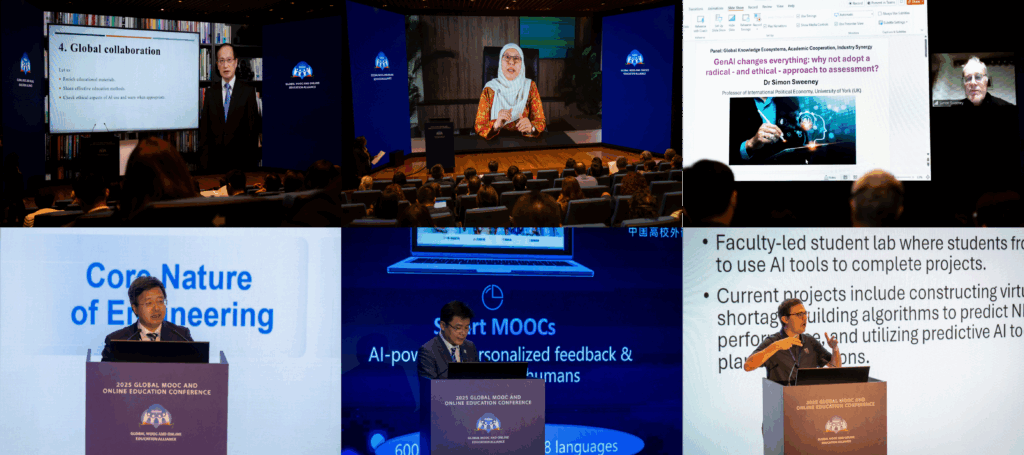
During the Keynote Presentations, Yasushi Asami, Executive Director and Vice President / Director of the Center for Research and Development of Higher Education of The University of Tokyo, shared an advanced concept of AI/DX in higher education, using the University of Tokyo’s response to generative AI as a case. He reported that the University of Tokyo’s policy on AI tools in classes asked faculty to clarify their stance, focus assessment on learning processes, design tasks that are not easily solvable by AI, and avoid overreliance on AI-detection tools. He then introduced the practices of generative AI and education and argued that generative AI could both strengthen students’ skills and threaten autonomy if used uncritically.
Yatimah binti Alias, Vice-Chancellor of Universiti Malaysia Pahang Al-Sultan Abdullah, shared that universities were crossing new frontiers of knowledge, technology, and transformation, with AI at their core. She stressed that AI was redefining how we teach, learn, and envisioning the future of education. In Malaysia, education was seen as a bridge from the past to the future, and AI enabled wider opportunities across society. She highlighted expanding AI-related research and partnerships, close collaboration with government and global institutions, and Malaysia’s clear, ethical AI direction through the National AI Office.
Simon Sweeney, Professor of International Political Economy of the University of York presented that generative AI had fundamentally changed assessment and posed serious risks to academic integrity. Drawing on teaching experience, students now rely on machine translation and GenAI, resulting in fluent but generic work that was difficult to verify as their own. He proposed radical reforms: banning machine translation tools, expanding viva voce, offline and closed-book exams, debates, and project-based assessment.
Zhao Xianzhong, Vice President of Tongji University, presented an insightful overview on cultivating innovative engineers for the AI era, especially when school learning lags behind rapid technological and industrial change. He emphasized that integrating theory with practice and strengthening industry–academia collaboration through Tongji University’s National College of Elite Engineers, which uses digital systems for project-based admission and enterprise–university–government co-training. Zhao also highlighted a “dual-track” global outreach model, both “bringing in” and “going global” via international joint degrees and the Tongji–Kenya College of Elite Engineers to nurture globally competitive elite engineers.
Tyler Cook, Assistant Program Director of Center for AI Learning of Emory University, examined human–AI teaming as a collaborative model where humans and AI worked together to outperform either alone. He argued that AI offered rapid computation and pattern recognition, while humans provided contextual judgment and ethical reasoning. He introduced Emory’s Center for AI Learning and its AI. Data Lab, where students used AI on real projects, from nursing workforce planning to NFL performance prediction and city planning, while critically reflecting on benefits like augmentation, efficiency, and risks such as overreliance, deskilling, and responsibility gaps.
Zhao Gang, Vice President of Beijing Foreign Studies University, presented the frontier research at the intersection of AI and human languages. He introduced a comprehensive ecosystem including book series, journals, and the MOE Laboratory of Philosophy & Social Sciences, together with R&D platforms such as “LingTrans1” for low-resource translation, “LingNet” for knowledge graphs, and “LingTutor” for virtual simulation teachers. He showed how AI-powered personalized feedback, digital humans and virtual simulation courses had supported international discussion and role-playing. He also presented the integrated “AI Teachmate” and “GlobalLink” platforms, which had enhanced assessment, academic support, and the preservation of linguistic diversity.
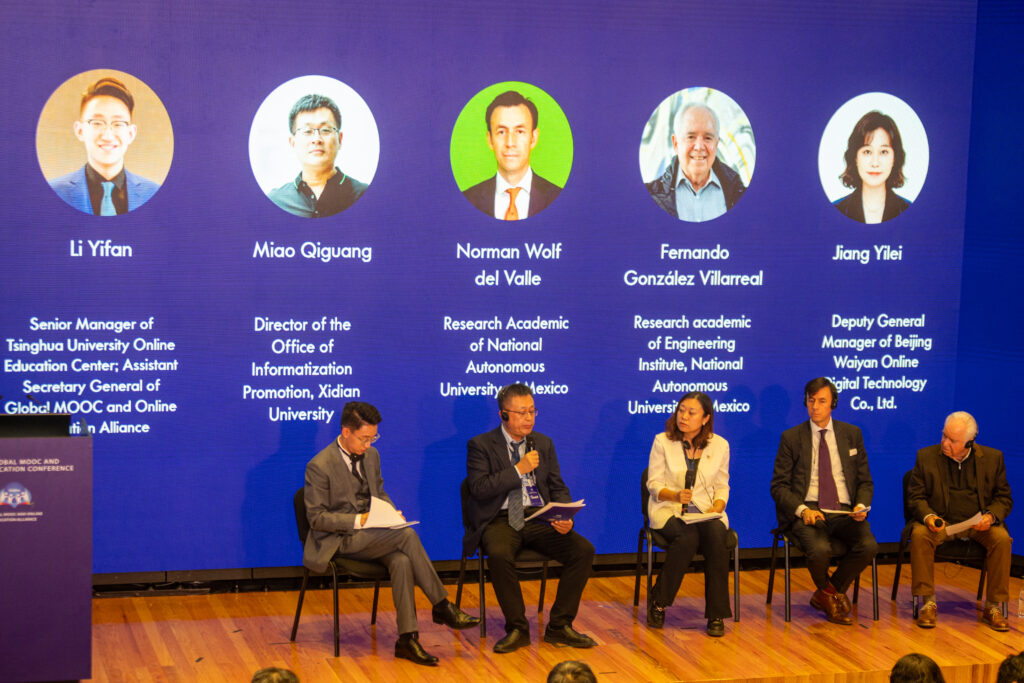
During the Panel Discussion, panelists engaged in insightful and productive conversations. Miao Qiguang, Director of the Office of Informatization Promotion, Xidian University, raised the challenge of how to ensure consistent quality of student training between universities and industries. He emphasized that establishing a shared standard for student training acceptable to both parties would be essential to guarantee coherence and sustainability in collaboration.; Norman Wolf del Valle, Research Academic of National Autonomous University of Mexico, stressed the importance of a strategic, long-term mission alignment, a stakeholder-centered approach, and integrity in order to ensure that education initiatives between universities and industries remained effective and impactful; Fernando González Villarreal, Research Academic of Engineering Institute, National Autonomous University of Mexico, emphasized the necessity of establishing explicit rules for collaboration to build trust among academia, industry, government, and civil society. He pointed out that overcoming the distinct “languages” and timelines of different sectors is crucial, and advocated for a student-centered approach where knowledge is applied to real-world problems; Jiang Yilei, Deputy General Manager of Beijing Waiyan Online Digital Technology Co., Ltd., introduced three principles for strengthening university–industry synergy. First, learning outcomes had to be ensured so that learners could truly improve and contribute to solving global issues. Second, academic goals needed to be aligned with real industrial needs. Third, learning had to be effectively connected to doing through authentic practice, enabling students to apply knowledge in real-world contexts.
Together, the panels exchanged ideas on how institutions can build resilient knowledge ecosystems, share expertise across regions, and harness collaboration to accelerate innovation while ensuring inclusive participation. The speakers reflected on challenges in research and teaching, stressing inclusive participation, shared standards, and sustainable support systems for students and educators.
The Keynote Presentations and Panel Discussion were moderated by María Teresa González Villatoro, COIL Coordinator of National Autonomous University of Mexico, and Li Yifan, Senior Manager of Tsinghua University Online Education Center, Assistant Secretary General of Global MOOC and Online Education Alliance, respectively.