

The 2025 Global MOOC and Online Education Conference, themed “Breaking Boundaries and Reshaping Futures: Open and Intelligent Global Education,” was held at the National Autonomous University of Mexico (UNAM) from December 2 to 4, local time. The opening ceremony was attended by Li Luming, president of Tsinghua University and chair of the board of the Global MOOC and Online Education Alliance; Patricia Dávila Aranda, general secretary of National Autonomous University of Mexico; and Asha Kanwar, chair of the UNESCO IITE Governing Board. Stefania Giannini, UNESCO assistant director-general for education, delivered a video address to the conference.
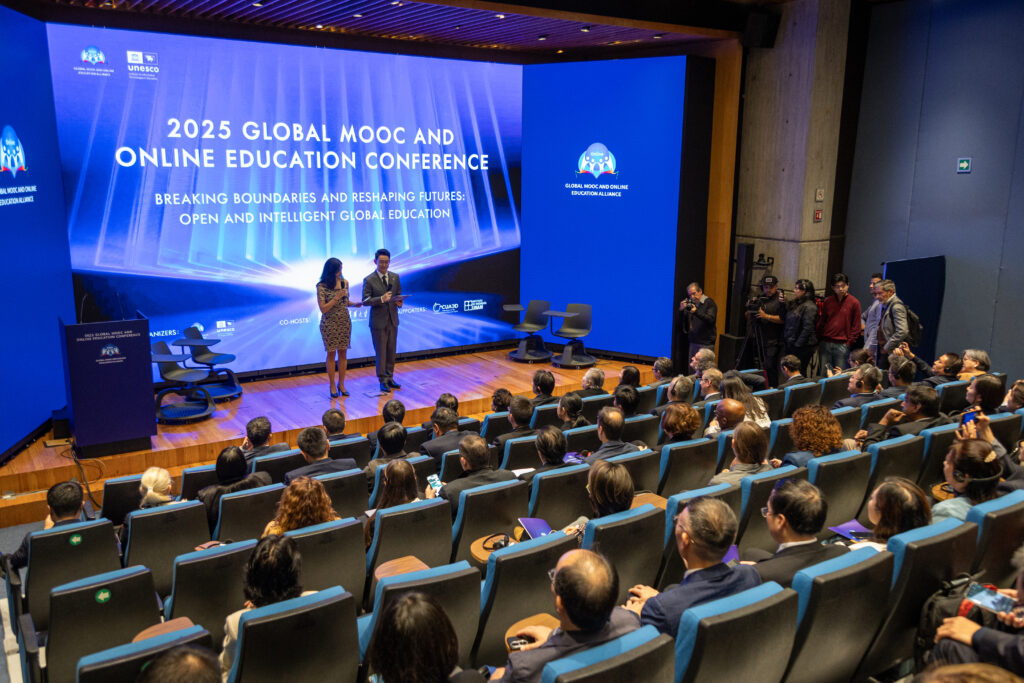
The 2025 Global MOOC and Online Education Conference, held at the National Autonomous University of Mexico (UNAM) from Dec 2 to 4, local time.
The meeting brought together 180 participants from 76 leading institutions, including Tsinghua University, Peking University, Cornell University, and the University of Auckland, among others. These representatives hailed from renowned universities, online education platforms, international organizations, and government agencies across 34 countries and regions worldwide.
Li Luming extended a warm welcome and thanked distinguished guests in attendance. He reviewed the Alliance’s work over the past year across four key areas: Quality, Equity, Community, and Wisdom, and announced the official inclusion of Vietnam National University, Hanoi, and the Federal University of Rio de Janeiro, as new members of the Global MOOC and Online Education Alliance.
In his keynote address titled “Dissolving Boundaries: Educational Innovation for a Future Learning Ecosystem,” Li Luming provided an in-depth analysis of the practical pathways for universities in the AI era to break down disciplinary barriers, overcome temporal and spatial constraints, and redefine institutional roles. He introduced Tsinghua University’s explorations in building an “AI-native” educational model and advancing the transformation of educational paradigms. Furthermore, he called upon universities worldwide to join forces in leveraging intelligent technologies to transcend the boundaries of time, space, disciplines, and traditional teacher-student roles, thereby collaboratively shaping a more inclusive and resilient future learning ecosystem.
Giannini highly commended the Global MOOC and Online Education Alliance for its contributions to promoting equity and inclusive development in global education. She called upon the international community to strengthen cooperation to ensure that the outcomes of educational transformation benefit every learner.
Dávila expressed her hope that universities worldwide would seize the opportunity presented by this conference to work together in building a more inclusive, intelligent, and human-centered educational ecosystem.
》及《世界高等教育数字化发展指数(2025)》-1024x682.jpg)
Infinite Possibilities: Report on the Digital Development of Global Higher Education (2025) and The Digital Development Index of Global Higher Education (2025) are released.
Li Luming, Dávila, Kanwar, and Anabel de la Rosa Gómez, coordinator of coordination of Open University and digital education of National Autonomous University of Mexico, jointly released the Infinite Possibilities: Report on the Digital Development of Global Higher Education (2025) and The Digital Development Index of Global Higher Education (2025). Drawing on the expertise and insights of over a hundred global experts and scholars, these publications were compiled over six months and systematically outline a strategic blueprint for the global transition of higher education from “digital adaptation” to “intelligent advancement.” They introduce new AI-specific indicators, such as access to educational large language models and AI ethics governance, and provide a multidimensional analysis of digital development trends in education across 101 countries, offering more comprehensive and precise data and guidance to support the creation of an open, inclusive, and equitable new educational ecosystem in the intelligent era.
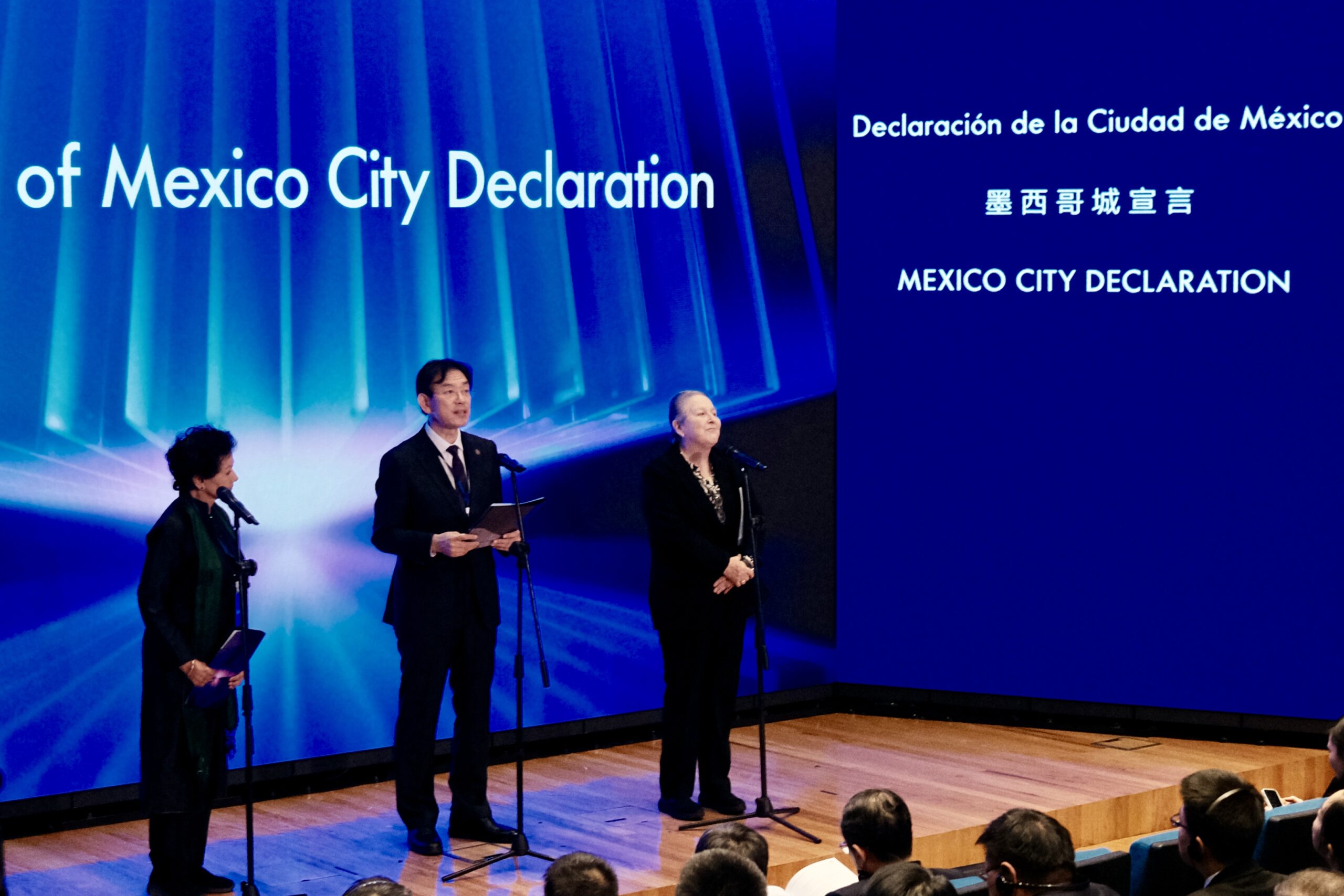
The Alliance releases the Mexico City Declaration.
The conference also featured the release of the Mexico City Declaration by Li Luming, Dávila, and Kanwar. This declaration stands as another landmark achievement for global higher education following the 2020 Beijing Declaration on MOOC Development. Focusing on the trends of higher education transformation in the AI era and upholding five core principles—”Promote Inclusive and Equitable Access, Uphold Student-Centered Development, Prioritize Quality and Excellence, Strengthen Ethical and Responsible Use of Technology, and Enhance Exchange and Collaboration”—it advocates for the implementation of five specific actions to jointly build a smart education community.
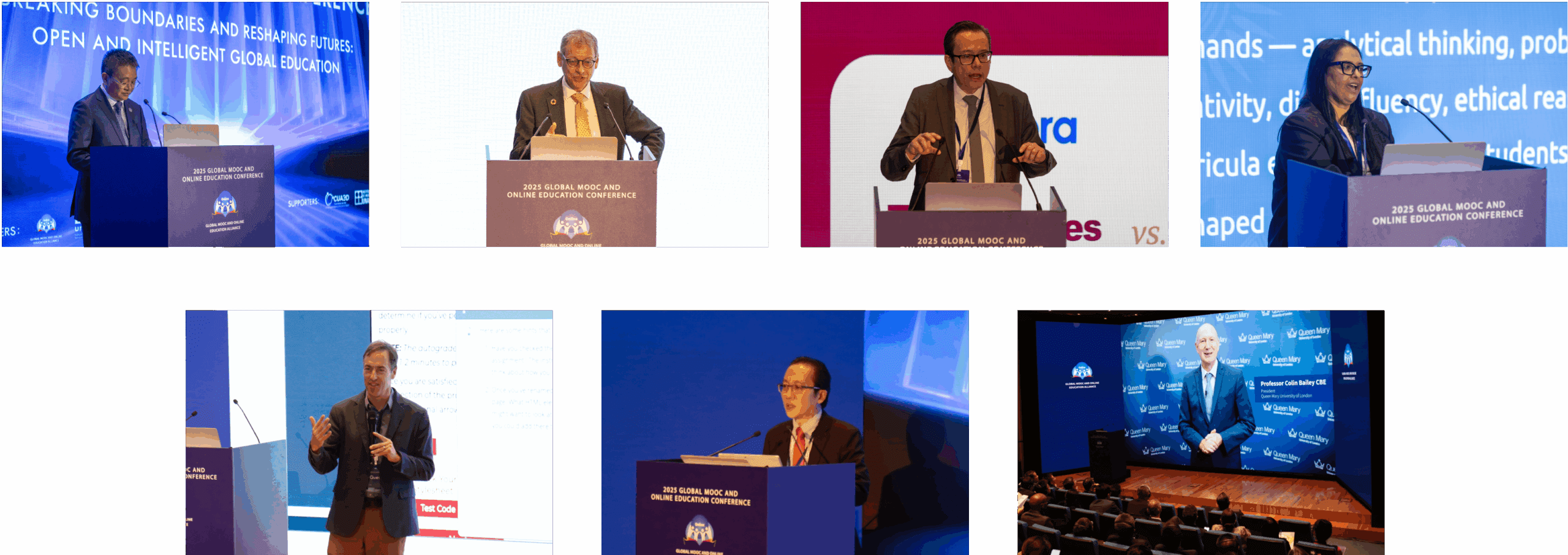
Keynote presentations
Hosted by Peng Gang, Vice President and Provost of Tsinghua University and Chair of Executive Committee of the Global MOOC and Online Education Alliance, the Keynote Presentations session features critical insights from five global experts. They delivered insightful presentations on how higher education must reinvent itself in the intelligence era.
Andreas Timm-Giel, President of Hamburg University of Technology, shared his view on future engineering education driven by Humboldt and AI. He emphasize the importance of tecnological innovation and global collaboration to deal with the climate change. He also shared the experience of “Educating the Best Engineers for Challenged Global World” from Hamburg University, and highlighted the vitality of engineering education to stimulate expected technology revolution. Facing an everchanging world, he also rise several questions regarding engineering education, including how to education necessary social skills, how to maintain an independent and free education in a challenged world, among many others. In the end, he put forward his proposal on “Global Hybrid Education” characterized by MOOCs & AI empowerment, global connectivity, and campus education.
León Aceves Díaz de León, Coordinator of Special Projects and Social Outreach at the Undersecretariat for Higher Education of the Ministry of Public Education of Mexico, said open, inclusive and intelligent education lies at the core of Mexico’s higher education policy amid rapid technological change. He warned that traditional university models risk becoming obsolete as skills and jobs evolve faster than curricula. Aceves argued universities must become flexible, lifelong learning spaces that embrace technology while humanizing it with strong ethical and social purpose. He emphasized the role of online education and MOOCs in reducing inequality, recognizing diverse forms of learning, and promoting social mobility through accessible, continuous upskilling.
Sehaam Khan, Deputy Vice-Chancellor of University of Johannesburg, emphasized using university values to guide human-centric AI in higher education. She argued that inclusivity must ensure AI expands opportunity rather than deepening inequality, especially given unequal educational backgrounds and linguistic diversity. She stressed innovation should strengthen, not replace, critical thinking, warning against overreliance on generative AI. On impact, she urged universities to move beyond narrow AI tools toward curriculum transformation aligned with real professional use. Finally, she highlighted integrity, calling on universities to cultivate ethical, responsible AI users.
Paul Krause, Vice Provost for External Education of Cornell University, argued that AI should reinforce, not replace, the human core of online education. He traced the evolution of online learning toward an AI-driven era and stressed that Cornell’s strategy remains grounded in strong pedagogy, instructor feedback, and peer interaction. Krause said AI can enhance learning through interactive feedback, simulations, localization, and instructor support, while freeing faculty to focus on emotional connection and mentoring. He also called for blended models that combine online learning with local, on-the-ground support to maximize social impact.
Michael Fung, Executive Director of the Institute for the Future of Education of Tecnológico de Monterrey, said higher education has reached a defining moment, facing technological disruption, financial strain, demographic change and declining public trust. He argued universities must reinvent themselves from content providers into value creators that deliver lifelong, flexible and work-relevant learning. Fung stressed that AI, skills mismatches and geopolitical uncertainty are reshaping what and how universities should teach. He called for a new social contract in which universities strengthen communities, restore trust, and demonstrate public value by empowering individuals, supporting sustainable development and serving society more directly.

Panel discussion
Subsequently, Anabel de la Rosa Gómez led a dynamic panel discussion featuring three expert panelists. The panel discussion yielded profound insights into the intersection of digital transformation and education, bringing together diverse perspectives on AI application, international cooperation, and the future development of universities. Experts’ viewpoints not only addressed pressing issues such as ensuring transparency in AI-empowered education and strengthening capacity-building through collaborative initiatives but also sparked critical reflections on preserving core educational values amid rapid technological change. This dynamic and constructive dialogue laid a solid foundation for subsequent conference discussions, illuminating actionable pathways to harness technology for building more equitable, ethical, and innovative educational futures worldwide.
Nghiem Xuan Huy, Director of the Institute of Digital Education and Testing (VNU-IDT) at Vietnam National University, Hanoi, underscored the importance of establishing a transparent framework for AI applications in open and online courses to safeguard learning quality. He also emphasized the value of integrating real-world social practices into teaching methodologies to foster students’ creativity and soft skills development.
Maxim Jean-Louis, President and Chief Executive Officer of Contact North, advocated for global collaborative efforts in co-constructing AI ecosystems, rather than limiting its use to information source control and privacy protection. He noted that AI’s inherent learning and evolutionary capabilities have transformed teaching dynamics and encouraged higher education to invite AI agents into the conversations around AI’s potential.
Wang Shuaiguo, Director of Tsinghua University Online Education Center and Secretary-General of the Global MOOC and Online Education Alliance, shared Tsinghua’s experiences in AI-empowered teaching and learning and talent cultivation. He also highlighted two critical considerations: the immediate challenge posed by “AI-to-AI” interactions potentially hindering deep critical thinking, and the long-term question of defining universities’ core value in the digital age.
Anabel de la Rosa Gómez guided the discussions with insightful questions centered on balancing innovation and equality, promoting international cooperation, and upholding openness, thereby facilitating in-depth exchanges on key challenges and institutional barriers in the field.

Announcement of Vietnam National University, Hanoi as the 2026 co-host
The Conference announced that Vietnam National University, Hanoi (VNU Hanoi) will serve as the co-host institution of the 2026 Global MOOC and Online Education Conference. Following the announcement, VNU Vice President Pham Bao Son joined the stage for a commemorative photo. The Global MOOC and Online Education Alliance and VNU Hanoi jointly invite higher education leaders and experts from around the world to join the 2026 Conference in Hanoi, Vietnam, and continue the global dialogue on open and intelligent education. Representing the co-host institution of the 2024 GMC Conference, Colin Bailey, President of Queen Mary University of London, delivered remarks underscoring the spirit of continued partnership and the importance of sustaining strong collaboration through the Conference platform.
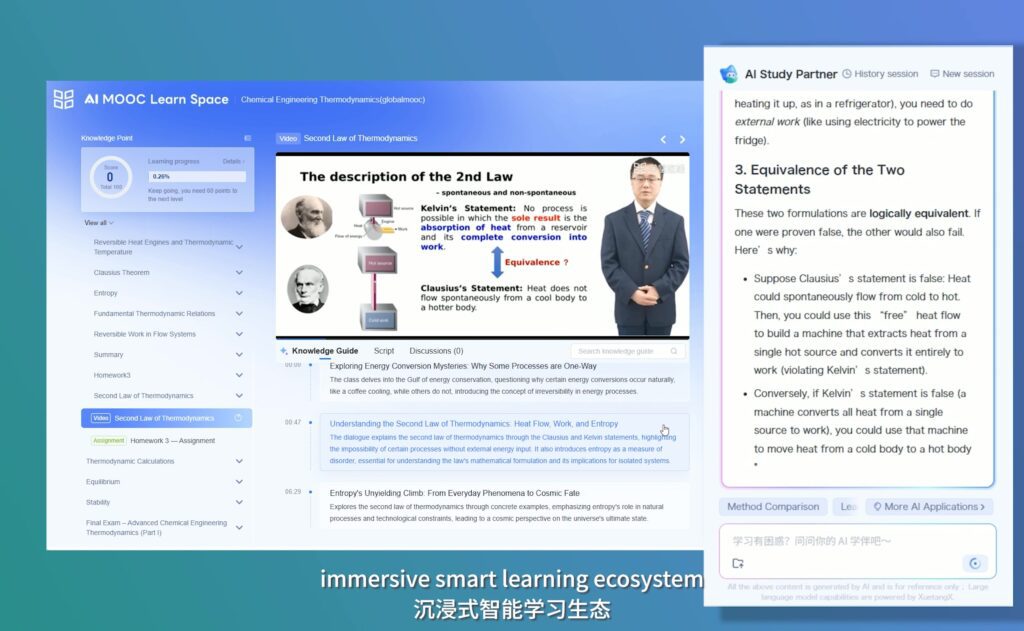
First global launch of Intelligent MOOCs
Another highlight was the first global launch of the new concept of “Intelligent MOOCs.” As a novel model, Intelligent MOOCs define a new course paradigm that leverages intelligent technologies to reshape the entire process of teaching, learning, management, and assessment, offering an innovative approach to enabling large-scale personalized education. Tsinghua University’s Chemical Engineering Thermodynamics course was featured among the first batch of Intelligent MOOCs.
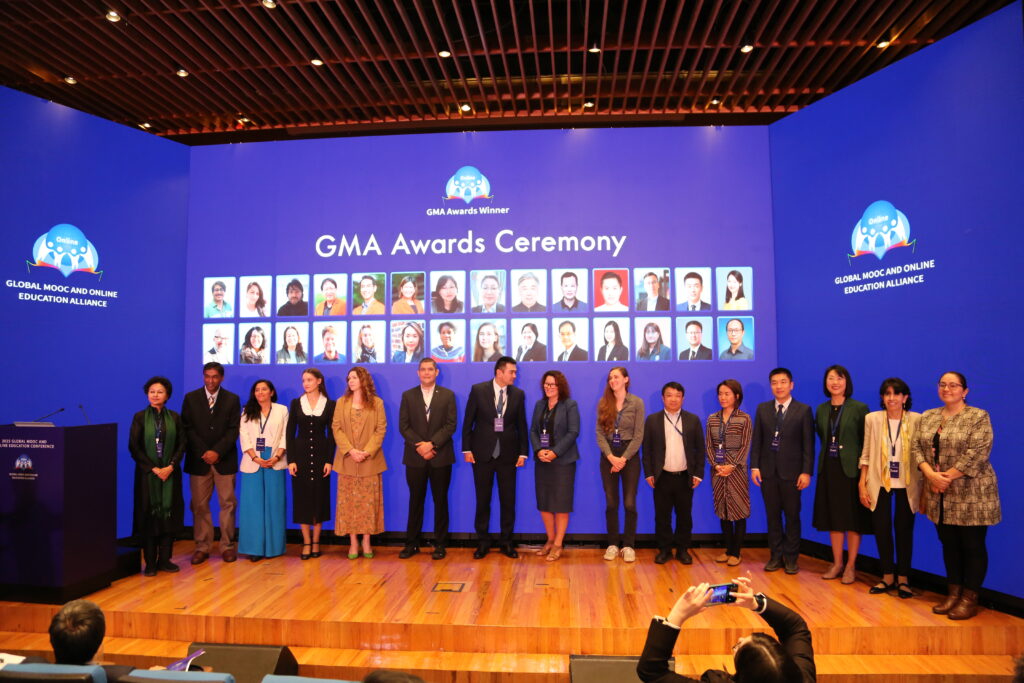
GMA Awards Ceremony
The Opening Ceremony also included the GMA Awards Ceremony, the Alliance’s annual global distinction celebrating excellence in STEM education and recognizing emerging innovation in AI-empowered pedagogy, marking a new level of global participation and visibility in 2025. A total of 20 outstanding courses were honored—10 Teaching Excellence Award winners and 10 AI Special Recognition Award winners—representing 14 countries across multiple regions. This year’s submissions were notably diverse, spanning engineering, computing, medical sciences, design, social sciences, and frontier interdisciplinary fields, with many institutions showcasing highly original approaches that integrate AI tutors, knowledge engines, and innovative assessment models.
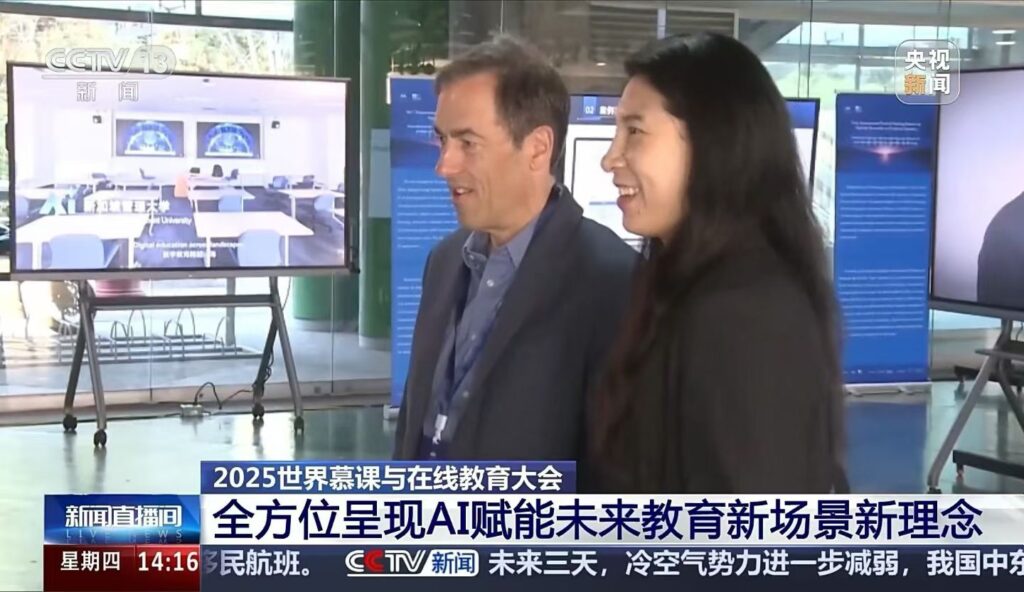
Intelligent Higher Education Exhibition
The agenda was further enriched by an Intelligent Higher Education Exhibition, showcasing a wide range of innovative, AI-empowered teaching outcomes across multiple dimensions. Through concrete cases and applied demonstrations, the exhibition highlighted how intelligent technologies are being integrated into teaching, learning, management, and assessment, offering a vivid illustration of emerging practices and future possibilities for higher education in the AI era.
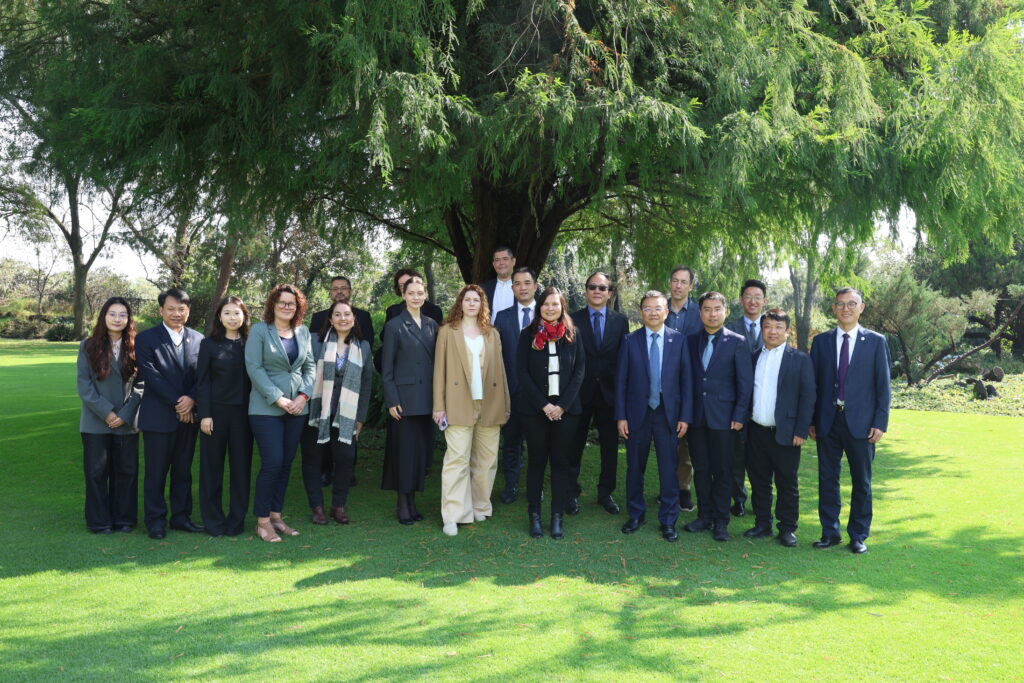
Members of the Global MOOC and Online Education Alliance Board Meeting gather for a group photo.
The event also featured four plenary sessions, a Special Global Workshop titled “AI for Futures,” and the Board Meeting of the Global MOOC and Online Education Alliance was held concurrently.
The Opening Ceremony was moderated by Li Yifan, Senior Manager of Tsinghua University Online Education Center; Assistant Secretary General of Global MOOC and Online Education Alliance and Anaïs Pereda, Head of Communication, Coordination of Open University and Digital Education of National Autonomous University of Mexico.