

On December 3rd, 2025, Mexico time, Plenary Session 1 of the Global MOOC and Online Education Conference, themed “Pedagogical Innovation, Educator Empowerment, and Emerging Learning Models” was successfully held. The session focused on the profound transformation of teaching and learning in the era of intelligence, and brought together institutional leaders, educators, and innovators from around the world to examine how universities are reshaping pedagogy through innovation, empowering educators through faculty development, and building new learning models for a new generation of learners. Through a global and diverse dialogue, the session set the stage for in-depth discussions on how higher education can respond to technological change while fostering inclusive, sustainable, and future-oriented learning ecosystems.
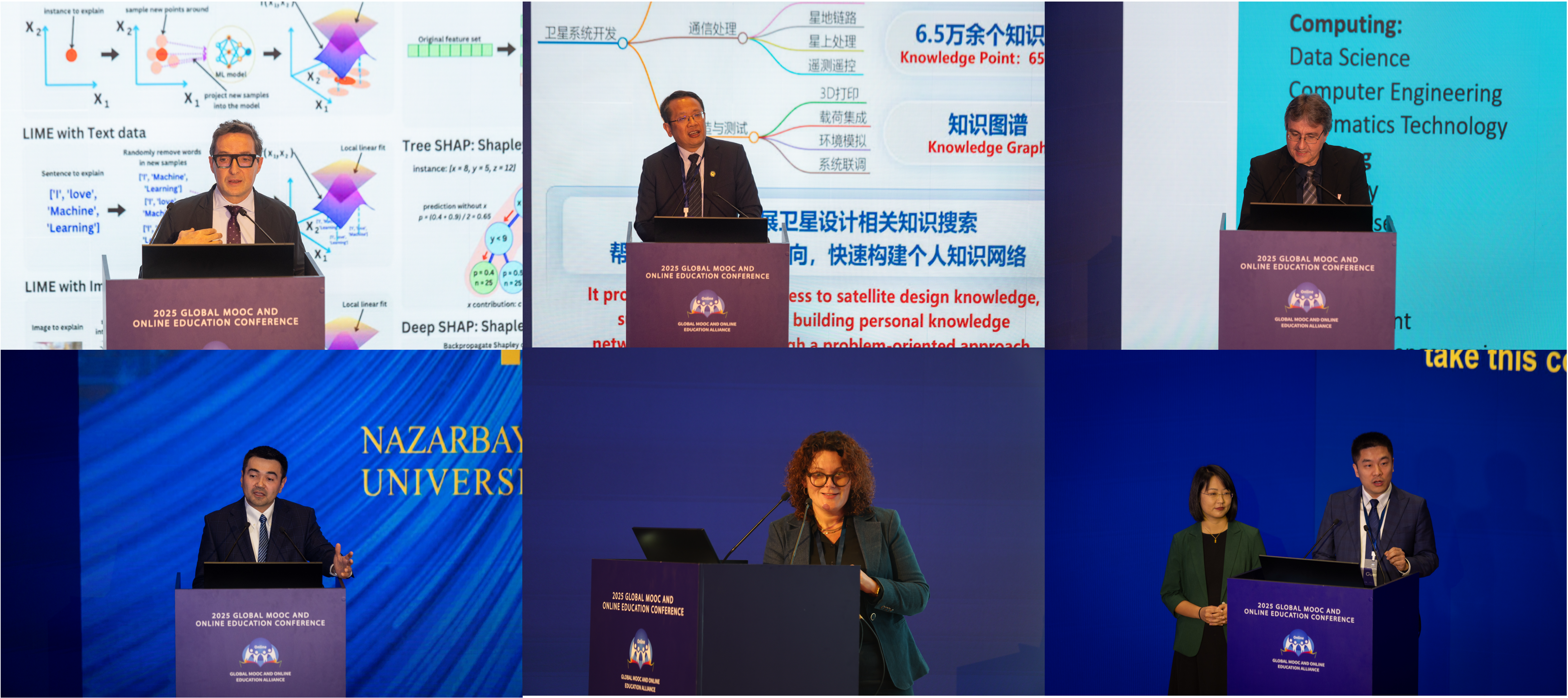
Juan Manuel Corchado, President of the University of Salamanca highlighted his views on AI-driven innovation in education, focusing on the growing role of Large Language Models and Retrieval-Augmented Generation. He emphasized that explainable AI is critical to ensuring transparency, accountability, and public trust in educational technologies. In his view, RAG strengthens the reliability of AI-supported learning by linking models to updated knowledge, enabling more personalized and responsive learning experiences. Corchado also noted the importance of multi-agent systems for collaborative learning and argued that AI can lower language and technical barriers, supporting more inclusive, globally accessible education while fostering critical thinking.
Xu Kun, President of Beijing University of Posts and Telecommunications outlined his view of “Human–Machine Collaboration” as a foundational paradigm for future engineering education. He argued that AI should be understood as a symbiotic partner rather than a simple technical tool, capable of reshaping how teaching and learning are organized. Xu highlighted persistent challenges such as the gap between rapid technological change and curriculum design, the high cost of engineering practice, and overly standardized evaluation systems. He emphasized the need for more open and networked educational models that integrate industry, digital platforms, and AI empowerment to support personalized, practice-oriented learning and holistic talent development.
Marcos Augusto Francisco Borges, President of the Virtual University of the State of São Paulo, shared his views on the role of large-scale public online universities in expanding equitable access to higher education. He emphasized that distance learning can effectively reach working adults, first-generation students, and learners in underserved regions when flexibility and academic quality are combined. Borges highlighted the importance of inclusive design, public-sector commitment, and strong media and technological support in building trust in online education. He argued that asynchronous learning, complemented by interactive support, is key to balancing accessibility with engagement, and that public online universities play a vital role in promoting social mobility, diversity, and lifelong learning.
Darkhan Bilyalov, Vice President of Nazarbayev University shared his perspectives on the importance of sovereign and inclusive generative AI for education. He emphasized that developing large language models tailored to local languages is essential for digital equity and meaningful educational access. Bilyalov argued that generative AI can strengthen national capacity while remaining open to global collaboration, particularly for regions with lower-resource languages. He highlighted the value of open-source ecosystems and research-based learning in cultivating future AI talent, stressing that education-oriented AI development should balance technological ambition with cultural relevance, accessibility, and international cooperation.
Natalie Cryan, Director of UoA Online at the University of Auckland, shared her views on aligning online education with evolving workforce needs. She emphasized that rapid growth in digital, AI, and green skills demand makes lifelong and mid-career learning increasingly essential. Cryan argued that effective online education should be flexible, modular, and closely connected to industry, enabling learners to upskill without leaving the workforce. She highlighted the importance of strong learner support during transitions, including academic preparedness and digital confidence. In her view, globally connected online platforms with stackable credentials can widen access, support professional mobility, and help universities respond more effectively to skills gaps in a fast-changing labor market.
Ma Yun, Assistant Professor of Institute for Artificial Intelligence of Peking University and Chen Mo, Lecturer of School of Computer Science of Peking University shared their perspectives on integrating AI education into the humanities and social sciences. They emphasized that computational thinking should be regarded as a core literacy rather than a technical specialization, enabling students to apply AI to real-world problems within their own disciplines. The speakers argued that AI education for non-technical students should focus on practical relevance, interdisciplinary application, and learning engagement instead of programming depth. They highlighted the value of integrated learning environments and AI-supported teaching assistants in lowering learning barriers, enhancing personalization, and motivating students, while underscoring the importance of broad AI literacy for fostering cross-disciplinary understanding and responsible use of technology.

During the Panel Discussion, panelists engaged in insightful and productive conversations. Indira Ochoa Carrasco, Director of Digital Transformation Projects for Education of National Autonomous University of Mexico, emphasized the importance of clear innovation rationales, continuous professional learning communities, and strong institutional support; María Luisa Zorrilla Abascal, Director of Multimodal Training of Autonomous University of the State of Morelos, stressed the value of educator co-creation, experiential training, and the necessity of long-term policy documentation that extends beyond administrative cycles; Arturo Mendoza Ramos, Dean of the School of National Languages, Linguistics and Translation of National Autonomous University of Mexico, focused on equipping language teachers with advanced digital and AI-related pedagogical tools while addressing critical challenges in assessment and interaction; Jorge Alfonso Rodríguez Tort, Director of Consulting and Alternative Credentials at the Institute for the Future of Education of Tecnológico de Monterrey, underscored the need for hands-on faculty development, integrated academic and technological support, and robust governance mechanisms to scale innovation effectively; and Zazil Sobrevilla Moreno, Coordinación de Español of National Autonomous University of Mexico, highlighted the importance of solid theoretical and methodological foundations, realistic resource planning, and sustained teacher involvement to ensure flexible and adaptable learning models.
Together, the panels exchanged ideas on how institutions can build resilient knowledge ecosystems, share expertise across regions, and harness collaboration to accelerate innovation while ensuring inclusive participation. The speakers reflected on challenges in research and teaching, stressing inclusive participation, shared standards, and sustainable support systems for students and educators.The Keynote Presentations and Panel Discussion were moderated by Li Hongru, Manager of Tsinghua University Online Education Center; Assistant Secretary General of Global MOOC and Online Education Alliance, and Karen Lizette Matias López, Coordinator of the Digital Learning Laboratory of National Autonomous University of Mexico, respectively.