

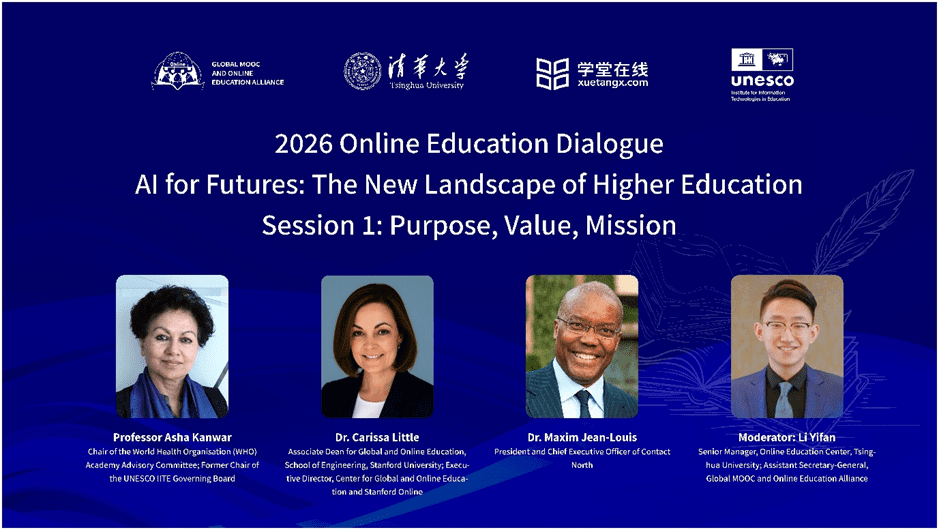
Co-hosted by the Global MOOC and Online Education Alliance (GMA), Tsinghua University, XuetangX, and UNESCO Institute for Information Technologies in Education (IITE), the first Online Education Dialogue (OED) session of 2026 was successfully held.
The session featured three distinguished speakers: Dr. Maxim Jean-Louis (President and Chief Executive Officer of Contact North), Professor Asha Kanwar (Chair of the World Health Organisation Academy Advisory Committee; Former Chair of the UNESCO IITE Governing Board), and Dr. Carissa Little (Associate Dean for Global and Online Education, School of Engineering, Stanford University; Executive Director of the Center for Global and Online Education and Stanford Online), who shared expert perspectives on the theme of “AI for Futures: The New Landscape of Higher Education.” The dialogue was hosted by Li Yifan, Senior Manager of the Online Education Center at Tsinghua University, and Assistant Secretary of the Global MOOC and Online Education Alliance.
Dr. Maxim Jean-Louis framed AI as a shift as consequential as writing, calculators, and search engines, but potentially deeper, because it may change how we think, not just how we work. Using the metaphor of an aircraft autopilot, he warned that the boundary between human and machine contribution to reasoning may become increasingly unclear, and that the real risk is not simply “students using AI,” but that certain forms of thinking may quietly disappear from learning as AI makes them easier to bypass and institutions gradually adapt. He argued that higher education must move beyond regulation and tool adoption to a more fundamental question: which kinds of thinking students must still practice themselves and why so that judgment, curiosity, and wisdom remain central in the AI era.
Professor Asha Kanwar situated AI within the wider global context of higher education, arguing that while AI is accelerating change in skills and labour markets, it also risks widening existing inequalities if governance and institutions do not keep up the pace with each other. Drawing on UNESCO dialogues and evidence from different regions, she highlighted urgent priorities such as closing the digital and AI divide, ensuring safety and human-centered learning relationships, and strengthening localization in tools, languages, and content. She also cautioned against embedded bias, particularly gender bias, and rising concerns around academic integrity, and illustrated how institutions are responding through “governance-first,” “context-first,” and “integrity-first” approaches. Looking ahead, she framed AI futures through “preferable, probable, and possible” scenarios, calling on universities to harness AI to expand access (including for underserved learners and persons with disabilities), move from massification to purposeful personalization, rethink assessment toward learning processes, and build lifelong “learnability” through collaboration across sectors.
Dr. Carissa Little shared Stanford’s long-standing mission to expand access to faculty teaching and research, and explained how the institution is approaching the AI era through “protected experimentation” with clear guardrails that allow rapid learning, controlled innovation, and the ability to pivot or shut down initiatives without institutional disruption. She highlighted a key challenge in higher education today: while generative AI is increasingly present in innovative projects, many institutions struggle to realize tangible returns due to strategic, competency, and technological barriers, often rooted in organizational and pedagogical change rather than technology alone. Through practical examples, she illustrated how AI can generate new insight into learner needs, enable scalable personalization when paired with human support, and strengthen instructional design—while cautioning that engagement does not automatically translate into better learning outcomes. She concluded by underscoring unresolved equity risks, the need to define meaningful outcome measures, and the importance of culturally responsive, responsible AI adoption at a global scale.
Panel Discussion
In the panel discussion moderated by Li Yifan, the speakers explored how higher education should redefine its core value in an AI-rich world where knowledge is abundant and instantly accessible. Jean-Louis emphasized that universities must increasingly help learners ask better questions, strengthening critical thinking and discernment. Kanwar expanded the discussion by referencing UNESCO’s “four pillars of learning,” stressing that in the AI era, higher education must move beyond “learning to know” and “learning to do” toward “learning to be” and “learning to live together,” reinforcing values, ethics, and global citizenship. Little added that the most durable focus should be on adaptability and learning-to-learn, while research-intensive universities can also use AI to accelerate knowledge creation and support learners in sustaining purpose and community across longer lifespans.
The discussion then examined the importance of learning, unlearning, and relearning, with panelists highlighting “unlearning” as especially difficult yet essential for progress, particularly in confronting bias, stereotypes, and misinformation amplified by AI. The speakers also considered the blurred boundary between AI-assisted learning and AI-substituted learning, agreeing that education should move learners from prompting for answers to using AI as a tool for discussion, reflection, and deeper inquiry. Little’s example, where increased AI-driven engagement did not necessarily improve performance, prompted further reflection on the need to rethink what outcomes matter and how learning should be measured in the AI era.
Finally, the panel also discussed collaboration among different stakeholders including universities, platforms, industry, and international organizations. Kanwar highlighted the convening power of organizations such as UNESCO, as well as their role in shaping ethical guidelines and strengthening capacity-building. The speakers also underscored the importance of meaningful and portable credentials, including the need for stronger international recognition frameworks and trusted digital credential infrastructure.
To conclude, each speaker offered a guiding adjective for the preferred future of higher education in the AI era: “ambiguous,” “fluid / non-linear,” and “inclusive,” capturing a shared vision of education that remains human-centered while evolving to meet fast-changing global needs.